

You can visit Zhangjiajie in any month; what changes is which mountain you get. The most comfortable months are late April to May and late September to October (skipping 1 to 7 October). For the sea of clouds, come for the mornings after rain, most often in spring and September. For snow on the pillars and the fewest people, January to mid February. Below are the actual monthly readings for 2024 to 2026, with a column for what the park is like that month.
Zhangjiajie weather by month (actual readings 2024–2026, city station)
| Month | Average high / low °C | Rainy days | Snow days | What the month is like |
|---|---|---|---|---|
| Jan | 11 / 4 | 10 | 2 | Coldest and quietest; the month snow is most likely; Tianmen on Line C (see note below) |
| Feb | 10 / 5 | 18 | 4 | Busy for Chinese New Year week, empty otherwise; snow in cold spells (ten days of it in 2024) |
| Mar | 17 / 10 | 18 | 1 | Warming up and wet; first sea-of-cloud mornings; peak-season period starts 1 March |
| Apr | 24 / 16 | 18 | 0 | Fresh green; cloud seas after rain; three busy days at Qingming |
| May | 28 / 20 | 16 | 0 | The most reliable month for the sea of clouds; the 1 May holiday week is the busiest of the first half |
| Jun | 29 / 23 | 18 | 0 | Rainy season (26 rainy days in 2024); cloud seas after rain; valley walks on the wet days |
| Jul | 35 / 27 | 10 | 0 | Hottest; afternoon showers rather than wet days; summer-holiday crowds |
| Aug | 34 / 26 | 7 | 0 | Hot and mostly dry; summer crowds; go in early |
| Sep | 30 / 23 | 8 | 0 | The driest month in recent years; frequent cloud seas; three slightly busy days at Mid-Autumn |
| Oct | 23 / 16 | 9 | 0 | The most comfortable month; 1 to 7 October is the busiest week of the year, quiet from the 8th |
| Nov | 19 / 10 | 9 | 0 | Few people, autumn colour; morning and evening fog; peak-season period ends 30 November |
| Dec | 13 / 5 | 6 | 0 | Dry and clear; no snow in December in 2024 or 2025; check winter cableway maintenance notices |
Figures are the averages of daily readings at the Zhangjiajie city weather station for 2024, 2025 and 2026 to date (October to December from 2024 and 2025). A rainy day is any day with rain recorded, including a short shower. The viewpoints on Yuanjiajie, Tianzi Mountain and the top of Tianmen are cooler than the city, and in rain or in winter they feel another five to eight degrees colder, so bring a jacket in any month. Months with many rainy days are not bad months, as the section on rain explains.
Month by month: what the mountains are like, and how we plan around it
January. The coldest and quietest month, and the one when snow is most likely: in each of the last three winters the snow came in January or February, never in December. When a cold front comes through, the top of Tianmen Mountain is covered in rime ice, a rare sight this far south. Tianmen Mountain is on Line C at the time of writing (gate, fast cableway, escalators to the summit) while its main cableway is upgraded, and in snow and ice Line C is the route in any case; the 999 steps ice over and get slippery, so wear shoes with grip. In the Forest Park the pillars turn white after snow, and Tianzi Mountain is the place to see it.
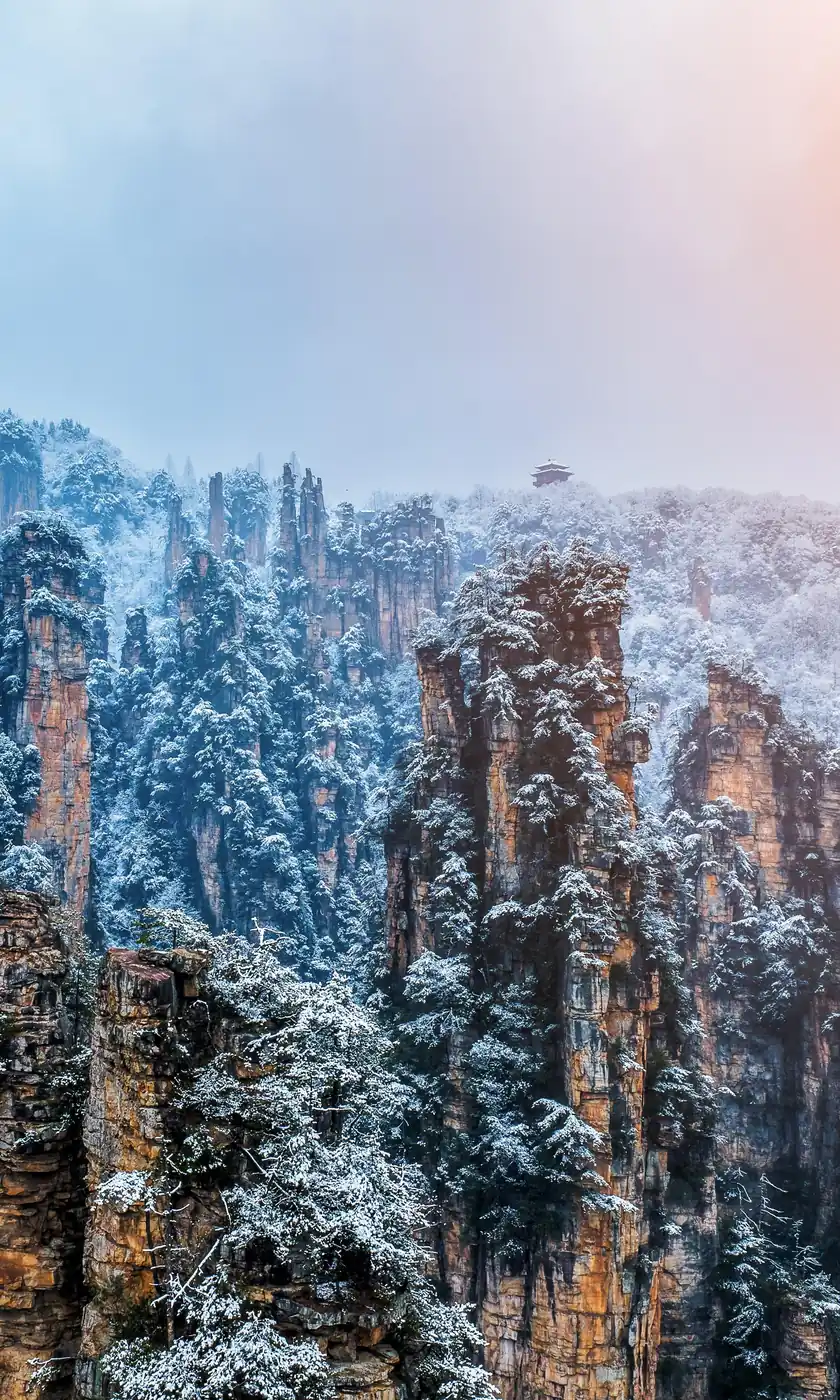
February. Still cold, and the other snow month: a cold front in February 2024 brought ten days of snow. Chinese New Year (6 February 2027, and the week around it) brings domestic crowds: in 2026 the Forest Park took nearly a fifth more visitors over the holiday than the year before, with peak days around 300,000. Outside that week the park is very quiet.
March. Warming up, and the rain starts: 16 to 21 rainy days in each of the last three years. The park’s peak-season period begins on 1 March, but the crowds have not arrived yet, and the mornings after rain start to bring the first cloud seas.
April. One of the most comfortable months. Fresh green everywhere, 14 to 22 rainy days in the last three years, and because it rains often, the chance of a cloud sea after rain is high. The three-day Qingming holiday in early April is busy.
May. Highs around 28 degrees and 15 to 18 rainy days. This is the most reliable month for the sea of clouds: rain overnight, into the park early, and the pillars rise out of the cloud. The 1 May holiday (five days from 1 May) is the busiest week of the first half of the year.
June. Rainy season: in 2024 it rained on 26 days of the month, with seven days of heavy rain. Warm but not stifling. The cloud seas come after rain just the same; on a day of heavy rain we put the valley walks, Golden Whip Stream and the Ten-Mile Gallery, and Yellow Dragon Cave on that day and keep the summits for the day it clears. In extreme rain the park can close for a short time (it happened once, in June 2025, and reopened three days later); we confirm on the morning.
July. The hottest month, with daily highs of 34 to 35 degrees in each of the last three summers, and fewer rainy days than you would expect (6 to 13), which tells you how the rain works here: mostly an afternoon shower that passes in an hour or two, not a wet day. Chinese school holidays begin and the park is busy, so getting in at 7 am matters most this month.
August. Just as hot and mostly dry: only three rainy days in August 2025. The summer crowds last to the end of the month. The pattern for August is in early, back to the hotel in the afternoon heat, out again in the evening.
September. The driest month of recent years (five or six rainy days in 2024 and 2026), highs easing to about 30 degrees, the clearest air, and another high-frequency month for the sea of clouds. The three days around Mid-Autumn Festival (15 September 2027) are a little busy; the rest of the month is one of the best windows of the year.
October. The most comfortable month, highs around 23 degrees, in three parts. 1 to 7 October is National Day Golden Week, the busiest week of the year: the park opens its gates at 6:30 and sells cableway and elevator tickets in limited batches, and we plan those seven days differently. From the 8th to the 15th the crowds drop away at once and hotel prices come down with them. From the 16th the autumn colour is at its best and the mornings and evenings turn cool.
November. Little rain, few people, autumn colour. Fog forms in the hills in the early morning and evening and usually lifts during the morning, so we put the summits in the later morning and the valleys first thing. The peak-season period ends on 30 November.
December. Dry and clear: six rainy days in both 2024 and 2025. Snow before January is rare; none fell in December in either year, and the first snow of the 2025 winter came on the very last day, 31 December. The park announces winter maintenance for the cableways and the Bailong Elevator each year, and we check the notices for you before you travel.
Rain is good news in Zhangjiajie
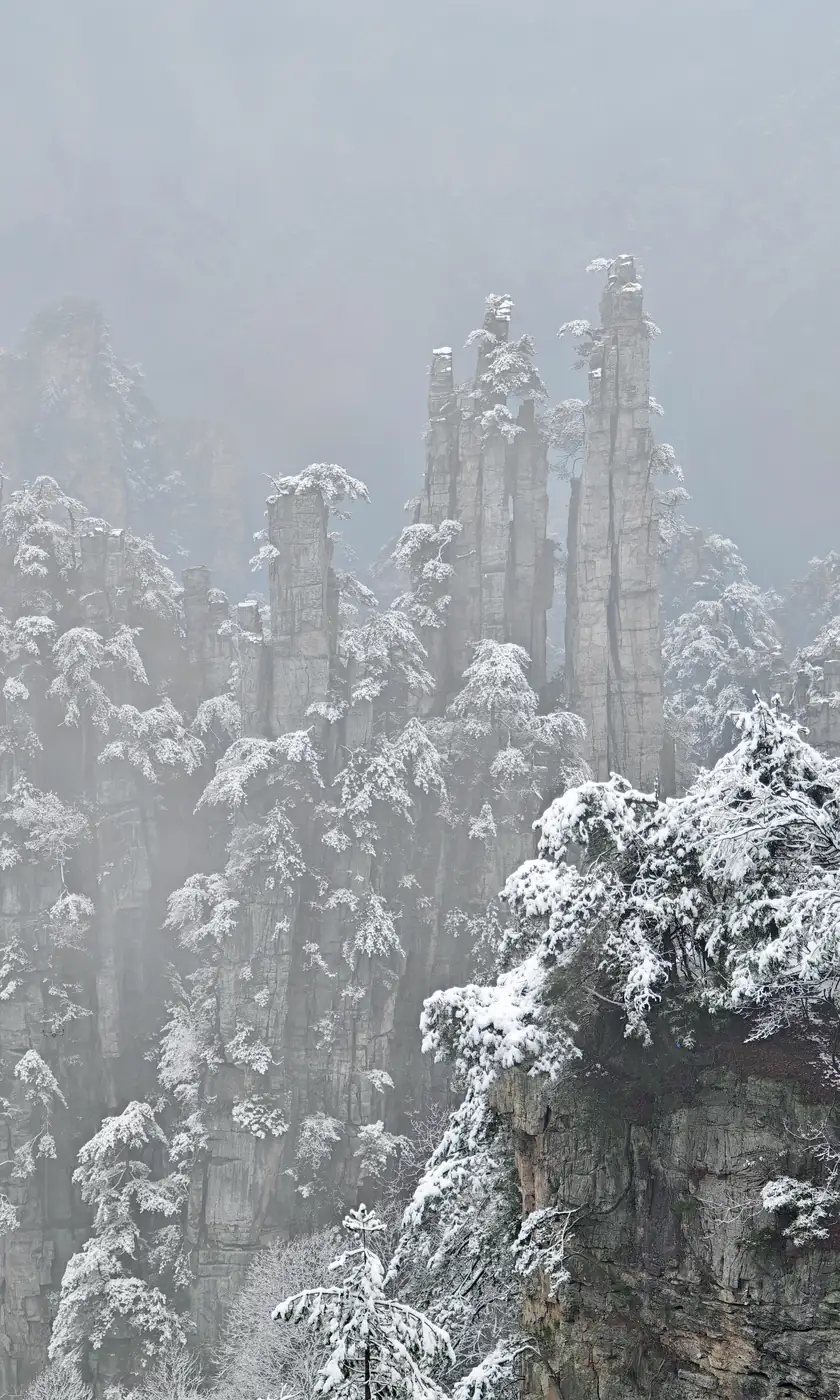
Zhangjiajie looks better after rain than in clear weather. The pillar forest gets its depth from moisture in the air, and the sea of clouds that rises out of the valleys once the rain stops is the most famous sight here; almost every photo of the “floating mountains” was taken after rain. So when the forecast shows rain, do not move your dates. Change the order of the days.
How the rain works
- Rain in the hills mostly comes in bursts, especially in autumn, and rarely lasts all day.
- The half hour to two hours after the rain stops is when the cloud sea is thickest. The surest time is five to seven in the morning after a wet night; before nine in the morning and after five in the afternoon are also good.
- On a rainy day, walk the valleys. Golden Whip Stream and the Ten-Mile Gallery look like an ink painting in the mist; Yellow Dragon Cave is underground at a constant temperature; Baofeng Lake is a boat ride. None of them is spoiled by rain. The glass bridge may close for the day in heavy rain, so we check before setting out.

- On the first morning after the rain, go up. The Bailong Elevator opens at 7, and on that morning we get you into the first group up to Yuanjiajie, or straight to Tianzi Mountain, where the peaks at Imperial Brush and Fairy Scattering Flowers look most like an ink painting when the cloud is in.
- In heavy rain, ice or thick fog, Tianmen Mountain runs Line C only (it is on Line C anyway while the main cableway is upgraded, since 13 October 2026); the Forest Park cableways follow the park’s notice for the day, and we confirm each morning before fixing the plan.
- What to wear: on the mountain a rain jacket beats an umbrella (the wind on the summits turns umbrellas inside out), shoes with grip, and keep the jacket on all day.
The two weeks to plan around
The heaviest crowds are not tied to the weather but to China’s public holidays: National Day Golden Week, 1 to 7 October, the busiest week of the year, and Chinese New Year (6 February 2027, and the week around it). You can still come in those weeks; we book early and put your park entries first thing in the morning. On 4 October 2026, guests who entered by the East Gate at 7 am went the whole day with almost no queues.
How a local team uses the weather
The weather in the mountains changes several times a day, and whether a morning is a sea of clouds or a wall of fog often comes down to a call made the evening before. Because we live here, we set the order of your park days from the previous night’s forecast: up the mountain on the morning after rain, the valleys on the wet days, and the far end of the park first on the busy days.
Here’s the part most month-by-month guides miss: in Zhangjiajie, how you visit matters as much as when. Weather in the mountains shifts fast, and the difference between a magical morning and a wasted one is often a local call made at 6am. One of our guests put it well after their guide adapted to a storm (translated from their original review):
“When a storm closed the road with landslides, she checked the satellite map, found another way round, and got us there safely. She planned around the crowds and made sure we still got eight hours’ sleep every night.”
So when should you go?
- Want the classic, comfortable trip? Aim for late April–May or late September–October (avoiding Oct 1–7).
- Chasing the sea of clouds? Spring mornings and the days right after autumn rain.
- Hate crowds / travelling on a budget? Late November to February.
- Tied to summer school holidays? Totally doable — we just build in early starts and a sensible pace.
Whatever your dates, we’ll tell you honestly what to expect that month and design around it. See what a private Zhangjiajie trip costs » or view our 5-day Zhangjiajie tour ».
Tell us your dates
Send us your dates and we will tell you honestly what that month will be like, then order your park days by the weather and the crowds. A personalised day-by-day itinerary with a clear price, in your inbox within two hours, free and with no obligation.
Frequently asked questions
Does it snow in Zhangjiajie in December?
Rarely. No snow fell in December in 2024 or 2025; the first snow of the 2025 winter came on 31 December. January and February are the snow months, and you are more likely to see it on the mountain than in the city.
What is the weather like in Zhangjiajie in October?
Highs around 23 degrees, lows around 16, and eight or nine rainy days in 2024 and 2025: one of the most comfortable months of the year. The only dates to avoid are 1 to 7 October.
Which month has the most rain?
In recent years June (26 rainy days in 2024) and the spring months, with 16 to 22 rainy days in March, April and May. The time after rain is the best time to see the sea of clouds.
Can I go up the mountain in the rain?
Yes. Light rain is fine, and the half hour to two hours after it stops is the cloud-sea window. On a day of heavy rain we switch to the valleys and Yellow Dragon Cave; in storms, ice or thick fog the cableways follow the park’s notice for the day.
Is winter worth it?
Yes. The fewest people, the chance of snow and rime ice in January and February, and December is dry and clear. It is cold, so bring a warm jacket and shoes with grip for the mountain. Tianmen Mountain is on Line C while its main cableway is upgraded (since 13 October 2026), and winter cableway maintenance in the Forest Park follows the park’s notices.
Which months are best for the sea of clouds?
April to June and September, on the mornings right after rain.
What should I pack?
A waterproof jacket in any season, and on the mountain a rain jacket rather than an umbrella; an extra layer in spring and autumn; gloves, a hat and shoes with grip in winter; sun protection and a change of clothes in summer.