
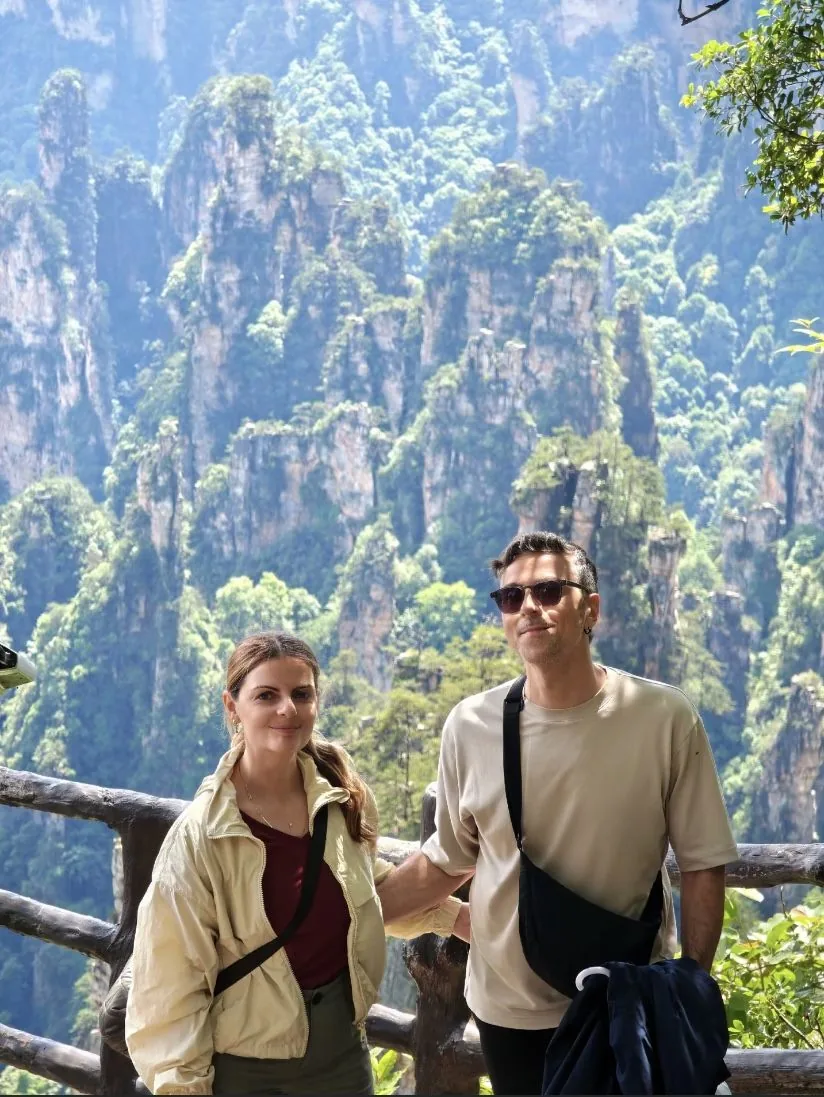
Short answer: Avatar was not filmed in Zhangjiajie — the 2009 film was shot on sound stages in Wellington and Los Angeles with CGI peaks, but Zhangjiajie’s quartzite-sandstone pillars were the real-world inspiration. To see them, take the Bailong Elevator (326 m, the world’s tallest outdoor lift) up to the Yuanjiajie viewpoint in Zhangjiajie National Forest Park. Park entry is CNY 236 for the combined admission and eco-bus pass (valid 4 days); the Bailong Elevator is a separate CNY 65 one-way ride.
Best for: travellers chasing the floating-mountain “sea of clouds” — arrive at the viewpoint around 6–7am in April–May or September–October. Think twice if: you only have a midday day-tour slot, when crowds peak and the morning mist has burned off — you will see the pillars, but not the scene that inspired Pandora.
Here is the honest answer most travel pages get wrong: Avatar was not filmed in Zhangjiajie. James Cameron’s 2009 film was shot on custom sound stages — Stone Street Studios in Wellington, New Zealand, and the Hughes Aircraft stage in Playa Vista, Los Angeles — and the floating Hallelujah Mountains were created with CGI. What Zhangjiajie’s towering quartzite-sandstone pillars gave the film was the real-world visual inspiration. So when people ask “where was Avatar filmed,” the truthful reply is: on a sound stage — but the place that actually looks like Pandora is very real, and you can stand in it.
We are a local team that lives and guides in Zhangjiajie, so we get this question almost weekly. This guide separates the myth from the fact, then shows you exactly how to reach the real Avatar Hallelujah Mountain viewpoint — including the sunrise window most day-tours miss.
So where was Avatar actually filmed?
Avatar (2009) was filmed on sound stages in Wellington, New Zealand and Los Angeles, with the floating mountains rendered digitally. No principal photography took place in China. Zhangjiajie’s pillars were a real-world reference for the look of Pandora, not a shooting location — an important distinction, because countless listicles still imply the movie was “filmed in Zhangjiajie,” which simply is not true.
The inspiration is also not pinned to a single mountain. An Avatar film designer cited “mainly the karst limestone formations in China… Guilin, Huangshan, and Zhangjiajie,” while James Cameron has publicly named Huangshan, describing the goal as to “recreate Huangshan Mountain in outer space.” A Hollywood locations photographer reportedly shot Zhangjiajie’s quartz-sandstone pillars back in 2008. The most accurate way to frame it: Pandora’s floating peaks were inspired by several of China’s karst-and-sandstone landscapes — chiefly Huangshan and the Zhangjiajie pillars — rather than copied from one filming site.
Why everyone calls them the “Avatar mountains”
In January 2010 — the same month Avatar was breaking global box-office records — Zhangjiajie officially renamed its “Southern Sky Column” (Qiankun Zhu) pillar to “Avatar Hallelujah Mountain” in a public ceremony, citing it as inspiration for the film. That single renaming is why “the real Avatar mountains” and “real Pandora China” are now firmly attached to Zhangjiajie in travellers’ minds. The marketing stuck because the resemblance is genuinely striking.
And here is the part photos rarely capture: the pillars never actually float. The illusion comes from morning mist that fills the valleys and hides the bases of the columns, so the peaks appear to hover. Reach the right viewpoint at the right hour and you see exactly the scene that inspired the film — no CGI required.
Where are the real Avatar mountains? (Yuanjiajie & the viewpoint)
The Avatar Hallelujah Mountain viewpoint sits in the Yuanjiajie area of Zhangjiajie National Forest Park, which is part of the larger Wulingyuan Scenic Area. The pillars are real quartzite-sandstone peaks — thousands of them across the park — and Yuanjiajie is the platform that overlooks the most Pandora-like cluster, including the renamed Avatar Hallelujah Mountain itself.
The classic way up is the Bailong Elevator (the “Hundred Dragons Elevator”), the world’s tallest outdoor elevator at 326 metres (1,070 ft), built into a quartzite cliff. It rises 326 m in about 88 seconds, carries up to 64 passengers per car, opened in 2002, and was certified by Guinness World Records on 16 July 2015. Note it is a separate paid ride, not included in the park ticket: the standard one-way fare is CNY 65 (about USD 9) as of 2026.
For the full lay of the land — Yuanjiajie, Tianzishan, Ten Mile Nature Gallery and more — see our Zhangjiajie National Forest Park guide, and our pick of the best photo spots in Zhangjiajie for where to point your camera.
How to visit the Avatar mountains in 2026
To see the real Avatar mountains, ride the Bailong Elevator (or hike the trails) up to the Yuanjiajie area inside Zhangjiajie National Forest Park, then walk to the Avatar Hallelujah Mountain viewpoint. Here is the practical detail, verified as of June 2026.
Tickets and what they cover
- The Zhangjiajie National Forest Park combined entry and eco-bus ticket is CNY 236, valid for 4 days with multiple entries, and includes the in-park eco-buses (admission-only is CNY 165).
- The same ticket covers the wider Wulingyuan area — Tianzishan, Yangjiajie, and the Ten Mile Nature Gallery (Suoxiyu).
- An annual pass is CNY 310.
- The Bailong Elevator is paid separately (one-way CNY 65, about USD 9).
Getting to Zhangjiajie
Most international visitors fly into Changsha Huanghua International Airport, then take a high-speed train to Zhangjiajie West Railway Station — more than 30 bullet trains run daily (roughly 06:00–19:30), and the journey takes around 1.5–3.5 hours depending on the service. Zhangjiajie also has its own Hehua Airport (DYG) with domestic flights, for example about 2.5 hours from Shanghai Pudong. Full routes and timings are in our how to get to Zhangjiajie guide.
The sunrise strategy (this is the one that matters)
The single best move is to reach the Yuanjiajie / Avatar Hallelujah Mountain viewpoint at sunrise — roughly 6–7am — in spring or autumn, before the day-tour crowds arrive. Autumn mornings in particular produce a “sea of clouds”: overnight humidity above 90% pools in the valleys and burns off at sunrise, so the pillars genuinely look like they are floating. This is precisely the window large group tours cannot offer, and where a local guide who lives here earns their keep.
Best time to visit the Avatar mountains
The best time to visit is April–May or September–October, when temperatures sit around 15–25°C and the air is either lush (spring) or crisp (autumn). September–October has the most reliable weather and the most frequent sunrise cloud seas — but it is also the busiest stretch of the year, which is the strongest argument for an early start and a private itinerary. For a month-by-month breakdown, see our best time to visit Zhangjiajie guide.
Do you need a visa? (240-hour transit option)
Since 20 August 2026, China’s 240-hour (10-day) visa-free transit policy has applied to 57 eligible countries — including the US, the UK and Australia — and covers 65 ports across 24 regions, including Hunan province (Changsha). It requires onward travel to a third country or region with a valid onward ticket, and the 10-day count starts at 00:00 the day after you enter. If you plan to stay longer, or you are not transiting onward to a third country, you will need a tourist (L) visa instead. Visa rules change, so always confirm the current policy before booking — this is exactly the kind of detail we double-check for every traveller we plan for. See our China visa guide for the full picture.
Plan it with a team that lives here
Most “Avatar mountains” articles end with a generic listicle. We do something different, because we are a local team based in Zhangjiajie — not a Beijing or Shanghai agency outsourcing the work. Every tour we run is 100% private and tailor-made (never a group of strangers), with English-speaking guides only, no shopping stops, and no hidden commissions. That is what makes the never-rushed sunrise window at Yuanjiajie actually possible: your guide can have you on the viewpoint at 6am while the buses are still loading in town.
Our 5-day Zhangjiajie private tour starts from around $680 per person (by group size) and includes a complimentary cinematic drone aerial video of your trip — the same fantasy-IP experience that draws people to the real Avatar world in the first place. Browse a few sample routes in our best Zhangjiajie itinerary ideas.
Tell us your dates and we’ll send a personalised PDF itinerary within 2 hours. Start with plan my trip, message us on WhatsApp at +86 189 7441 2915, or email info@chinafantasytravel.com — and we’ll get you standing where Pandora’s mountains came to life.
Sources
- Guinness World Records: tallest outdoor elevator
- National Immigration Administration: Announcement No. 4 of 2026, 240-hour visa-free transit extended to 57 countries (20 August 2026)
- UNESCO World Heritage Centre: Wulingyuan Scenic and Historic Interest Area