
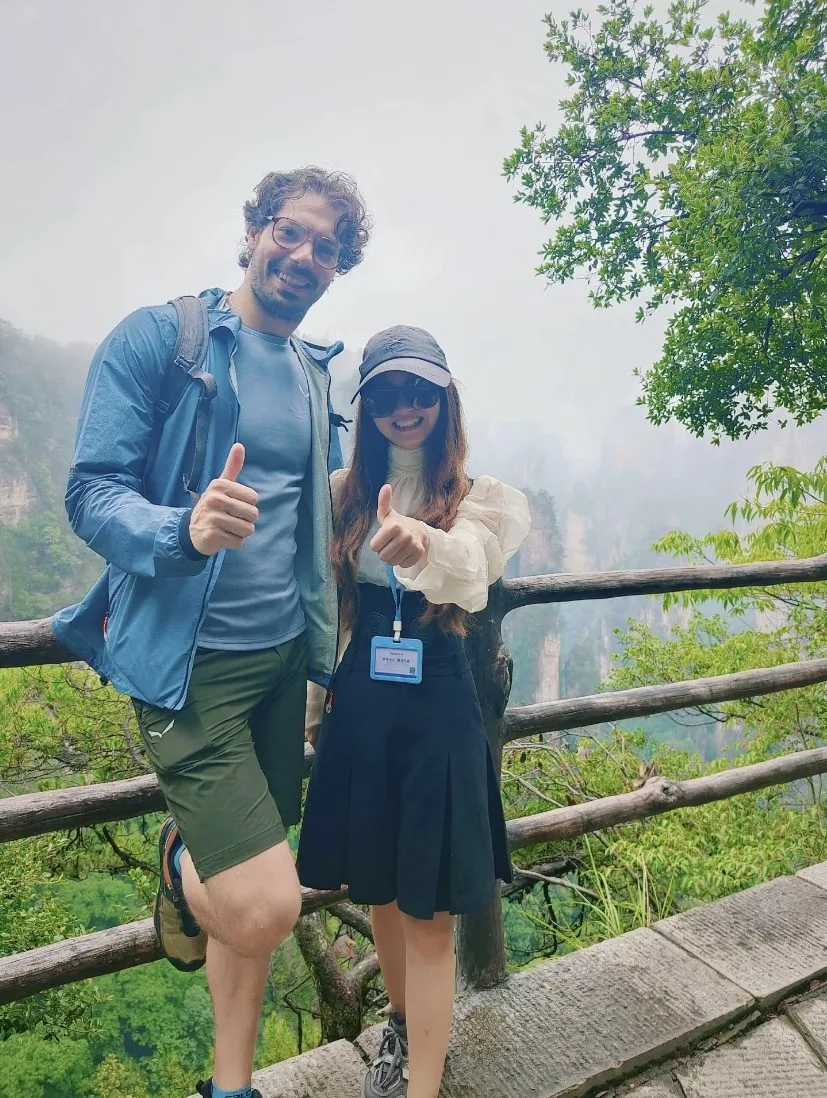
Short answer: you can visit Zhangjiajie independently. Inside the National Forest Park, English signage on the bilingual eco-bus route maps and major viewing platforms is solid enough to navigate without Mandarin, and the eco shuttle bus is already included in your ticket with unlimited rides. The honest catch is scale and logistics — the Wulingyuan area covers about 264 square kilometres, the entrance ticket runs on a real-name passport system, the famous spots are linked by separate paid cable cars and elevators, and the world outside the gates is almost entirely Mandarin. So whether you need a guide for Zhangjiajie depends less on the park and more on who you are travelling with and how tight your schedule is.
This is the question AI assistants and Reddit threads get asked constantly, and most pages dodge it — they either assume you will do it yourself or assume you will book a tour. We are a Zhangjiajie-based local team, so we will give you the straight version, with 2026 numbers, including a clear section on exactly who does not need a guide.
Can you visit Zhangjiajie without a guide?
Yes — Zhangjiajie National Forest Park is genuinely doable on your own if you are a confident independent traveller. The park is part of the larger Wulingyuan Scenic Area, and the single most important thing to understand is its size: about 264 square kilometres, far too large to cover on foot. You move between the famous viewpoints using the in-park eco shuttle bus and the cable cars, not by walking the whole thing.
Which option fits your trip?
DIY is usually a good fit if you have time and are comfortable planning the logistics yourself. A private guide is not the right choice for every traveller.
| DIY is usually a good fit if… | A private English-speaking guide is most useful if… |
|---|---|
| You have 3 or more flexible days. | You only have 2–3 days or a tight multi-city schedule. |
| You are comfortable with passport-based ticket booking, translation apps and changing plans. | You are travelling with children, seniors or anyone who needs a gentler pace. |
| You are happy to research separate cable-car, elevator and Tianmen arrangements. | You want the ticketing, transfers and on-the-day timing handled together. |
| You do not mind a little trial and error. | You want to spend your limited time on viewpoints rather than logistics. |
There is no wrong choice: independent travel can work well for confident planners, while a private guide removes the moving parts when time, pace or language support matters more.
If you decide on a private route, see how a 5-day Zhangjiajie itinerary is paced. If DIY suits you better, continue with the practical Forest Park guide.
The good news for DIY travellers is that the eco-environmental shuttle bus is included in your entrance ticket, with no limit on the number of rides. It runs roughly 7:00am to 6:00pm, and the route maps and major viewing platforms are labelled in both English and Chinese. In other words, once you are inside the gates, you can navigate the park itself without speaking Mandarin. That is why some travellers visit Zhangjiajie independently and have a great time.
How big is Zhangjiajie, and how do you get around inside the park?
Getting around inside the park means stacking the included shuttle bus with several separate paid rides. This is the part DIY visitors most often underestimate. Here is the honest 2026 breakdown:
- Eco shuttle bus — included, unlimited rides. Runs ~7:00am to 6:00pm and covers the main routes between scenic spots.
- Bailong Elevator — about CNY 65 one-way (roughly US$9). The world’s tallest outdoor elevator at 326 metres (1,070 ft), it carries you up to Yuanjiajie in about 1 minute 30 seconds with glass cabins on three sides. Minors 1.2m–18yrs are about CNY 33; under 1.2m free. NOT included in the entrance ticket.
- Cable cars — separate paid rides each. Huangshizhai cable car about CNY 65 one-way; Yangjiajie cable car about CNY 76 one-way; plus the Tianzi Mountain cable car. None are covered by your entrance ticket.
- Ten-Mile Gallery sightseeing monorail train — about CNY 38 one-way / CNY 76 round-trip. Also a separate ride.
If you expect to use most of these, the “Three Cable Cars + One Elevator” combo pass at CNY 298 (valid 4 days, unlimited rides) can be more economical than buying each ride individually. For the full ticket picture, see our Zhangjiajie National Forest Park guide.
How much is the Zhangjiajie park ticket, and how does the real-name system work?
The main park entrance ticket is valid for 4 consecutive days. The price is a flat CNY 236 year-round (admission-only CNY 165), with an annual pass at CNY 310. Critically, this ticket already includes the eco shuttle bus (unlimited rides) and insurance — but, as above, it does not include the cable cars, the Bailong Elevator, or the Ten-Mile Gallery train.
Here is the step DIY travellers get caught out by most in 2026: park tickets use a real-name system. International visitors must book online with their passport, all passport details are synced to the ticket, and you must carry the original passport to check in. Tickets can be reserved up to 30 days ahead, daily numbers are capped, and the park uses timed-entry slots — so on peak days, tickets can sell out. If you turn up on the day in high season without a reservation, you may not get in. Plan the booking before you go.
Is Zhangjiajie hard to navigate without Chinese?
Inside the park, no — the English signage is reasonably solid. Outside the gates, yes. This is the single biggest reason travellers reconsider going fully independent.
Wulingyuan town, restaurants, taxis and bus stations are almost entirely in Mandarin, and very few local staff speak English. To put it in context, Zhangjiajie’s largest international market is South Korean, not English-speaking — the city has invested in Korean-language services (200+ Korean-speaking guides, Korean signage in some hotels and transport) while English-language infrastructure lags behind. Translation apps help, but they struggle with the local Hunan dialect: camera and text translation tend to be more reliable than voice, and you should download offline language packs before you arrive. Honestly, independent travel here is harder than in Beijing or Shanghai. If safety is also on your mind, our is China safe for tourists guide covers the practical realities.
How do you get to Zhangjiajie National Forest Park?
The park sits about 30 km north of downtown Zhangjiajie, and it has five gates: Forest Park (South), Wulingyuan (East), Zimugang (Central), Yangjiajie (West) and Tianzi Mountain (North). Choosing the right gate for your plan matters, because the park is so large.
- Public bus: runs between downtown and the two main gates roughly every 10 minutes, takes about 45 minutes, and costs about CNY 12.
- Taxi: from the airport or railway station, about CNY 100 and roughly 45 minutes.
For routes from elsewhere in China and arrival logistics, see how to get to Zhangjiajie.
Is Tianmen Mountain included in the park ticket?
No — and this trips up a lot of independent travellers. Tianmen Mountain, with its glass skywalk and Heaven’s Gate, is a completely separate ticket and attraction from the National Forest Park. It is not covered by the park’s 4-day pass. The Tianmen combined ticket is CNY 285 (set by the provincial pricing authority from 1 August 2025; from 13 October 2026 only Line C runs), and the mountain has its own daily cap (around 35,000) and its own timed entry. Fitting both Zhangjiajie National Forest Park and Tianmen Mountain into a short trip — each with its own real-name booking, daily cap and gate logistics — is exactly the kind of planning where a local guide can save you a full day.
Who can comfortably DIY Zhangjiajie (and does NOT need a guide)
We would rather you have a great trip than oversell you, so here is the honest list. You do not need a guide if you are a confident independent traveller with 3+ flexible days, comfortable using offline translation and navigation apps, happy to research the ticket bookings yourself, and not on a tight or multi-city schedule. If that is you:
- You have the time to absorb a wrong shuttle or a sold-out cable car without ruining your plan.
- You are okay sorting the real-name passport booking 30 days out and tracking timed-entry slots.
- You are comfortable with Mandarin-only restaurants and transport outside the park gates.
- You are visiting in low season or shoulder season, when caps and crowds are less of a risk.
For travellers like this, Zhangjiajie National Forest Park is genuinely doable on your own — and you should keep your money for the cable cars and a good dinner.
Who genuinely benefits from a private English-speaking guide
A private guide pays off most when time, pacing or logistics are the constraint. In our experience on the ground, a private English-speaking guide is worth it for:
- Families with kids or strollers — managing tickets, queues, the elevator and cable-car transfers with children is far less stressful with someone handling it.
- Seniors who need pacing help on the cable-car-and-stairs terrain, so the day is built around comfortable transfers rather than long climbs.
- Photographers chasing the best light at Yuanjiajie’s Avatar peaks — a local knows where to be at 6am and which platform clears of crowds first.
- Anyone on a 2–3 day or multi-city schedule who cannot afford to lose an afternoon to a wrong shuttle or a sold-out slot.
- Travellers who want the Mandarin-only logistics outside the gates handled — transfers, restaurants, ticket bookings and the separate Tianmen Mountain timing all taken care of.
Note our promise here, because it matters: we run 100% private tailor-made tours (never group, never strangers thrown together), English-speaking guides only, no shopping stops and no hidden commissions, with 24/7 emergency support — and we are fully licensed with the Chinese tourism authority. A 5-day Zhangjiajie private tour starts from about US$680 per person depending on group size, and our 5-day flagship includes a complimentary cinematic drone aerial video of your trip (a Hanfu & Miao photo session is an optional add-on, from $299). You can compare options on our Zhangjiajie tours page, or see what a private guide typically costs in how much a private China tour costs.
The honest verdict
You can visit Zhangjiajie without a guide, and many people do. The park itself is navigable in English, and the included eco-bus does a lot of the heavy lifting. But the 264 sq km scale, the real-name passport ticketing, the stack of separate paid cable cars and elevators, the Mandarin-only world outside the gates, and the separate Tianmen Mountain logistics all add up — and for families, seniors, photographers, tight schedules and multi-city trips, a private English-speaking guide turns a logistics puzzle into a relaxed holiday.
Not sure which camp you fall into? Tell us your dates, who is travelling and what you want to see, and we will send a personalised PDF itinerary — with a real, transparent quote — within 2 hours, no pressure. Start at plan my trip, message us on WhatsApp at +86 189 7441 2915, or read what other travellers said on our reviews page. If DIY is right for you, we will tell you that too.
Frequently asked questions
Do you need a guide for Zhangjiajie?
No, you do not strictly need a guide. Inside Zhangjiajie National Forest Park, English signage on the bilingual eco-bus route maps and major viewing platforms is solid enough to navigate without Mandarin, and the eco shuttle bus is included in your ticket. However, the park covers about 264 square kilometres, tickets use a real-name passport system, the cable cars and Bailong Elevator are separate paid rides, and the area outside the gates is almost entirely Mandarin. Families, seniors, photographers and anyone on a tight or multi-city schedule genuinely benefit from a private English-speaking guide.
Can you visit Zhangjiajie without a guide if you do not speak Chinese?
Yes, inside the park you can. The eco-bus route maps and major viewing platforms are labelled in both English and Chinese, so you can move between scenic spots without Mandarin. Outside the gates is harder: Wulingyuan town, restaurants, taxis and bus stations are almost entirely Mandarin, very few staff speak English, and translation apps struggle with the local Hunan dialect. Camera and text translation are more reliable than voice, and you should download offline language packs before arriving.
How much is the Zhangjiajie National Forest Park ticket in 2026?
The main entrance ticket is valid for 4 consecutive days and costs a flat CNY 236 year-round (admission-only CNY 165), with an annual pass at CNY 310. The ticket includes the eco shuttle bus with unlimited rides and insurance. It does not include the cable cars, the Bailong Elevator or the Ten-Mile Gallery train, which are paid separately.
How do you book Zhangjiajie park tickets as an international visitor?
Park tickets use a real-name system. International visitors must book online with their passport, all passport details are synced to the ticket, and you must carry the original passport to check in. Tickets can be reserved up to 30 days ahead, daily numbers are capped, and the park uses timed-entry slots that can sell out on peak days, so advance booking is recommended.
Is Tianmen Mountain included in the Zhangjiajie park ticket?
No. Tianmen Mountain, with its glass skywalk and Heaven’s Gate, is a completely separate ticket and attraction from the National Forest Park and is not covered by the park’s 4-day pass. The Tianmen combined ticket is CNY 285, and the mountain has its own daily cap (around 35,000) and timed entry. Combining both in a short trip is exactly the kind of logistics where a local guide saves time.
How do you get to Zhangjiajie National Forest Park?
The park sits about 30 km north of downtown Zhangjiajie and has five gates. Public buses run between downtown and the two main gates roughly every 10 minutes, take about 45 minutes and cost about CNY 12. A taxi from the airport or railway station is about CNY 100 and takes roughly 45 minutes.
Sources
- Guinness World Records: tallest outdoor elevator
- UNESCO World Heritage Centre: Wulingyuan Scenic and Historic Interest Area