
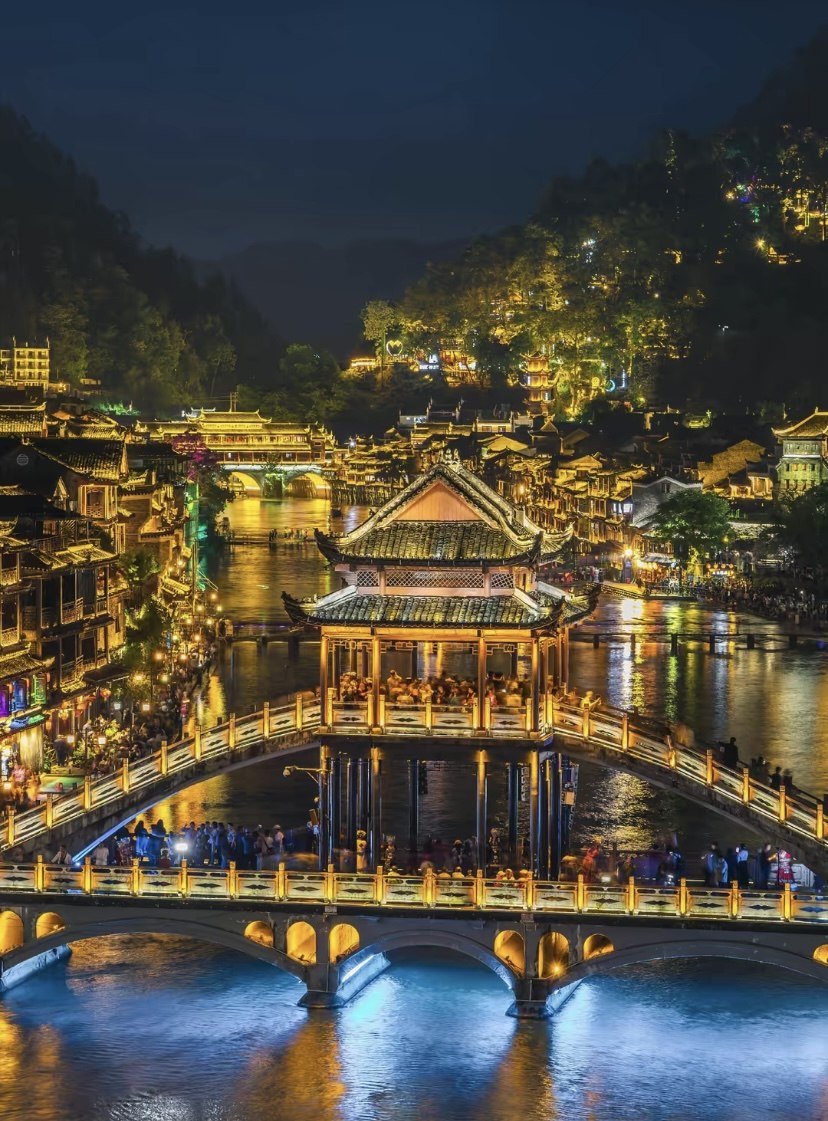
Fenghuang Ancient Town is a riverside Qing-dynasty town in western Hunan’s Xiangxi Tujia and Miao Autonomous Prefecture, where stilted wooden houses (diaojiaolou) line the Tuojiang River. The walled town dates to 1704, more than half its people are Miao or Tujia, and it was the hometown of the writer Shen Congwen, author of the novella Border Town. If you do only one thing right here, do this: stay overnight. The daytime old town is pretty, but the real magic is after dark, when red lanterns on the riverside stilt houses glow in the water and a night boat glides past them. This Fenghuang Ancient Town travel guide is written by a local team who run guests through here most weeks of the year – what to see, when to go, and how to reach it from Zhangjiajie.
Fenghuang Ancient Town at a glance (quick facts)
Here is the short version for Phoenix Ancient Town in China – the numbers most travellers ask us first. Prices and schedules change, so treat these as a planning guide and confirm on arrival.
- Where: Fenghuang County, Xiangxi Tujia and Miao Autonomous Prefecture, western Hunan, on the Guizhou border.
- Founded: the present walled town was built in 1704 (Qing dynasty); originally a military outpost called Zhen’gan before 1913.
- Entry: walking the ancient town is FREE; a combo ticket of about 128 RMB (roughly USD 18, valid 48 hours) covers the nine core sites.
- How long to stay: 1 to 2 nights (the combo ticket is valid 2 days).
- Best time to visit: spring (April-May) and autumn (September-October).
- Getting there: about 230-240 km from Zhangjiajie – roughly a 4 to 4.5 hour private-car drive, or about a 1-hour bullet train.
- UNESCO status: on the UNESCO World Heritage Tentative List (added 28 March 2008); it is not yet a full World Heritage Site.
What is Fenghuang Ancient Town, and why go?
Fenghuang (which means “phoenix”) is one of China’s best-preserved old riverside towns, and it feels genuinely lived-in rather than staged. The settlement’s roots run deep, but the walled town you walk today was built in 1704, in the 43rd year of the Kangxi reign, originally as a military outpost. What survives is well-kept Ming and Qing architecture: narrow flagstone lanes, ancestral halls, temples, and the famous cluster of diaojiaolou – cantilevered stilt houses in Miao style that hang out over the Tuojiang River.
It is also a place with a literary soul. Shen Congwen (1902-1988), one of modern China’s most loved writers and author of the novella Border Town (Bian Cheng), was born here; his former residence in the old town is one of the core ticketed sites. That heritage, plus the strong Miao and Tujia ethnic culture – more than half the county’s population belongs to those groups – is what gives Fenghuang a texture you simply do not get in a generic “ancient town” rebuild. For our guests it pairs perfectly with the otherworldly peaks of Zhangjiajie: nature for a few days, then living culture by the river.
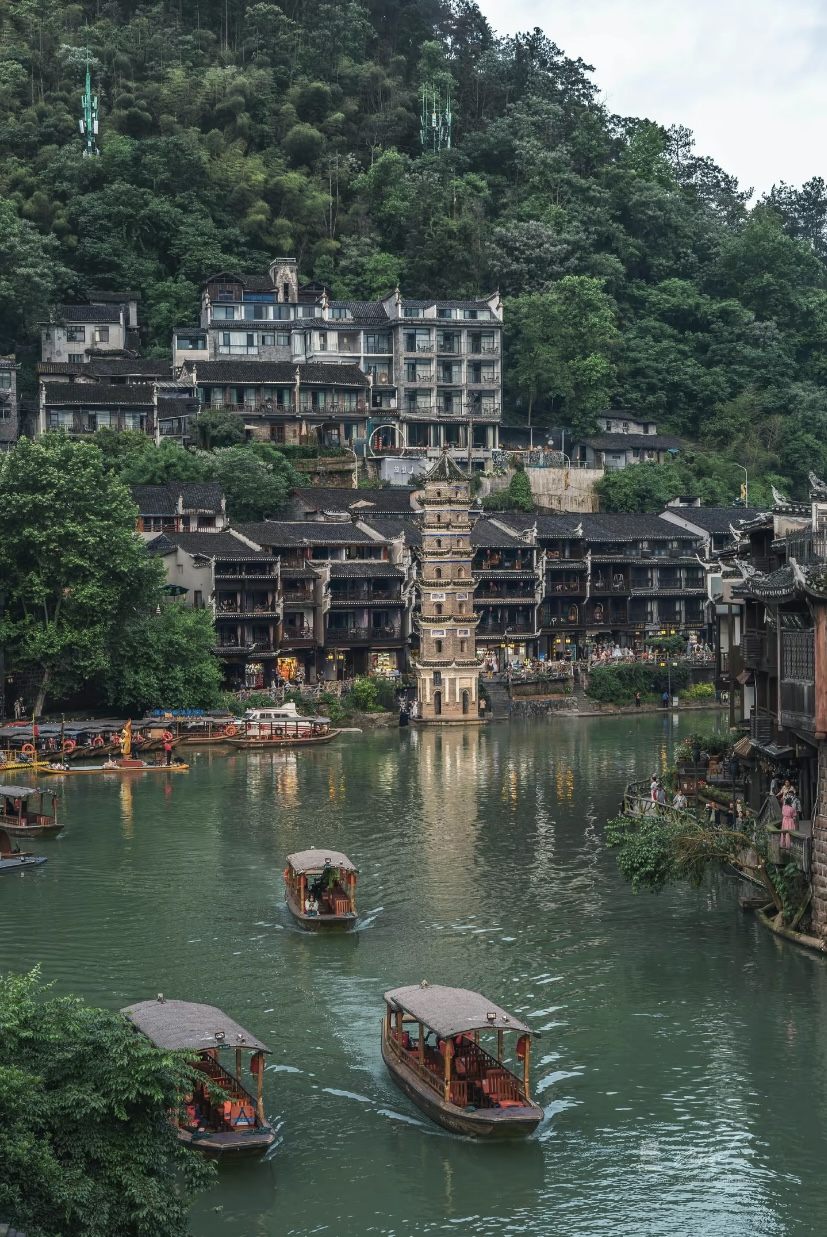
Fenghuang Ancient Town: things to do
You can see the headline sights in a relaxed full day plus one night. Here are the ones worth your time.
- The Tuojiang River and diaojiaolou stilt houses: the town’s mother river and its signature view. The stilted-house cluster near Huilong Pavilion runs about 240 metres in Miao architectural style and is the single most photographed spot in town.
- Hong (Rainbow) Bridge: a covered Ming-style bridge over the Tuojiang, beautiful by day and lit up at night. It is one of the nine combo-ticket sites.
- The stepping stones (tiao yan / “jumping stones”): a line of stone piers about 100 metres long, with around 15 piers, crossing the river. Go at dawn for mist over the water.
- The ancient city wall and gate towers: Ming-era wall remnants run about 1.8 km, with four preserved gates, including the East Gate Tower.
- Shen Congwen’s Former Residence: the writer’s birthplace and a quiet, atmospheric stop for anyone who has read Border Town.
- The other heritage halls: Longevity Palace (Wanshou Gong), Xiong Xiling’s Former Residence, the Yang Family Ancestral Hall, Chongde Hall, and the Fenghuang Ancient Town Museum round out the combo ticket.
How tickets work in Fenghuang
Entering and wandering Fenghuang Ancient Town is free. To go inside the heritage buildings, a combo ticket of about 128 RMB (around USD 18) covers the nine core attractions and is valid 48 hours: Shen Congwen’s Former Residence, Tuojiang River boating, Longevity Palace, Xiong Xiling’s Former Residence, the Yang Family Ancestral Hall, the Hong (Rainbow) Bridge, Chongde Hall, the Fenghuang Ancient Town Museum, and the East Gate Tower. Some agencies quote wider bundles at 138, 208 or 248 RMB; the price varies by package and is subject to change, so verify on arrival. The Tuojiang boat rides are usually charged separately when bought on their own – a day cruise is roughly 76 RMB and the night cruise roughly 138 RMB (prices vary).
Fenghuang night light show and Tuojiang River boat ride
Fenghuang is best experienced overnight, not as a day trip. After dark the whole riverfront switches on: red lanterns string along the diaojiaolou, the Rainbow Bridge and gate towers light up, and the reflections double everything in the Tuojiang. This is the “Fenghuang night light show” that fills travellers’ photos – not a single staged performance, but the town itself glowing. The Tuojiang River boat ride is the way to take it in: drifting past the illuminated stilt houses from the water is the highlight of most guests’ visit. Boats run from North Gate Wharf or Wanshou Wharf. Then come back to the same spot at dawn, when mist hangs over the stepping stones and the lanes are nearly empty – the two faces of Fenghuang, dawn-mist and after-dark, are why we always tell people to sleep here.
Day trip or overnight? The honest verdict
Overnight, almost every time. A day trip lets you see the lanes, the bridge and the stilt houses, but you miss the single best thing the town offers – the lantern-lit night and the night river cruise – and you fight the heaviest crowds in the middle of the day. Plan on 1 to 2 nights: one full day and one night comfortably covers the stilt houses, Rainbow Bridge, ancient city wall, stepping stones, Shen Congwen’s residence and a night cruise without rushing. Two nights suits anyone who wants slow mornings, a walk in the surrounding Miao countryside, or simply to feel the place rather than tick it off.
Best time to visit Fenghuang Ancient Town
The best times to visit Fenghuang Ancient Town are spring (April-May) and autumn (September-October), when the weather is mild and clear – roughly 15-25 C (59-77 F) in spring – and early-morning mist drifts over the Tuojiang and its century-old stepping stones. A quick season-by-season read:
- Spring (Apr-May) and autumn (Sep-Oct): the sweet spot – comfortable temperatures, clear light, and that signature dawn river mist.
- Summer (Jun-Aug): hot, humid and rainy, but with the liveliest nights – and the biggest crowds.
- Winter (Dec-Feb): cold, quiet and occasionally snowy; some attractions may need advance online reservation, so check ahead.
How to get to Fenghuang Ancient Town from Zhangjiajie
From Zhangjiajie, Fenghuang is about 230-240 km away, which is why the two destinations are almost always toured together. You have three main options:
- Private car (what most of our guests choose): roughly a 4 to 4.5 hour door-to-door drive, and the only option that lets you stop en route at Furong Town (more on that below). No station transfers, no waiting – door to door.
- Bullet train: about 1 hour from Zhangjiajie West to Fenghuang Ancient Town Station (the fastest, G6061, takes about 51 minutes), with roughly 8 trains a day between about 07:50 and 18:45, fares around USD 21-60. Note the station sits about 10 km (around 20 minutes by car) from the old town, so add a short transfer at the end. Schedules and fares change – verify before you book.
- Direct bus: about 4 to 4.5 hours; the budget option, but less flexible.
By air, the nearest airport is Tongren Fenghuang Airport (TEN, just over the line in Guizhou), about 30-40 km away with a shuttle of roughly 1.5 hours and flights from cities such as Beijing (~2.5 hrs) and Shanghai (~2 hrs). For most inbound travellers, though, the larger and more useful gateway is Zhangjiajie Hehua International Airport, which is the usual pairing – fly into Zhangjiajie, see the peaks, then continue to Fenghuang.
Fenghuang vs Furong Town: should you stop en route?
Many travellers add a stop at Furong Town (Hibiscus Town) on the way (train times from Zhangjiajie) – it sits between Zhangjiajie and Fenghuang and makes an easy, scenic break. Furong is a quieter ancient village built dramatically above a roughly 60-metre waterfall; by high-speed train it is about 25 minutes from Zhangjiajie and about 40 minutes from Fenghuang. The two are not rivals so much as complements: Furong is smaller, calmer and built around its waterfall, while Fenghuang is larger, livelier and built around its river and night scene. If you have the time, do both – a short waterfall-town stop by day, then the lantern-lit river town by night. A private car makes this effortless, since you simply pause in Furong instead of changing trains.
Let us handle the logistics
Fenghuang rewards a little planning – the right night for the river cruise, an overnight rather than a rushed day trip, and a clean hand-off from Zhangjiajie. Our local Zhangjiajie team lives here and runs this route year-round, so we can fold Fenghuang (and Furong Town) into a fully private, tailor-made trip with an English-speaking guide and no shopping stops, ever. The most popular version is our 7-day Zhangjiajie & Fenghuang private tour, which pairs the peaks with the river town and includes a Hanfu & Miao costume photo session and a Tuo River boat ride. Tell us your dates and we’ll send a personalised PDF itinerary within 2 hours – start at Plan My Trip, read real guest stories on our reviews page, or message us on WhatsApp at +86 189 7441 2915. You can also reach us any time via our contact page.
Frequently asked questions
Is Fenghuang Ancient Town worth visiting?
Yes, especially if you stay overnight. Fenghuang is one of China’s best-preserved riverside old towns, with Qing-dynasty stilt houses (diaojiaolou) lining the Tuojiang River, strong Miao and Tujia culture, and a literary heritage as the hometown of writer Shen Congwen. The lantern-lit night and night river cruise are the standout experience, so an overnight visit is far more rewarding than a day trip.
How much does it cost to enter Fenghuang Ancient Town?
Walking the ancient town itself is free. To enter the heritage buildings, a combo ticket of about 128 RMB (roughly USD 18, valid 48 hours) covers nine core sites, including Shen Congwen’s Former Residence, the Hong (Rainbow) Bridge and a Tuojiang River boat ride. Some agencies quote wider bundles at 138, 208 or 248 RMB, and prices change, so confirm on arrival. (Verified 2026-06.)
How do you get to Fenghuang Ancient Town from Zhangjiajie?
Fenghuang is about 230 to 240 km from Zhangjiajie. By private car it is roughly a 4 to 4.5 hour door-to-door drive (and the only option that allows an en-route stop in Furong Town). A bullet train from Zhangjiajie West to Fenghuang Ancient Town Station takes about 1 hour, but the station is around 10 km from the old town, so add a short transfer. Direct buses take about 4 to 4.5 hours. Schedules and fares change, so verify before booking.
How many days should you spend in Fenghuang Ancient Town?
Plan on 1 to 2 nights. One full day and one night comfortably cover the stilt houses, Rainbow Bridge, ancient city wall, stepping stones, Shen Congwen’s residence and a night river cruise without rushing. The combo ticket is valid for two days, and staying overnight lets you see the town both at dawn-mist and after dark.
What is the best time to visit Fenghuang Ancient Town?
Spring (April to May) and autumn (September to October) are best, with mild, clear weather (about 15 to 25 C / 59 to 77 F in spring) and early-morning mist over the Tuojiang River. Summer is hot, humid and rainy but has the liveliest nights and biggest crowds; winter is cold and quiet, and some attractions may need advance online reservation.
Should I visit Fenghuang or Furong Town?
Ideally both, since Furong Town (Hibiscus Town) sits between Zhangjiajie and Fenghuang and makes an easy en-route stop. Furong is a quieter village built above a roughly 60-metre waterfall, about 25 minutes from Zhangjiajie and 40 minutes from Fenghuang by high-speed train. Fenghuang is larger and livelier with its river and night scene; many travellers pause in Furong by day, then spend the night in Fenghuang.
Related guides
- Zhangjiajie, Fenghuang & Furong itinerary
- Zhangjiajie travel guide
- Best time to visit Zhangjiajie
- How to get to Zhangjiajie
- 7-day Zhangjiajie & Fenghuang private tour