
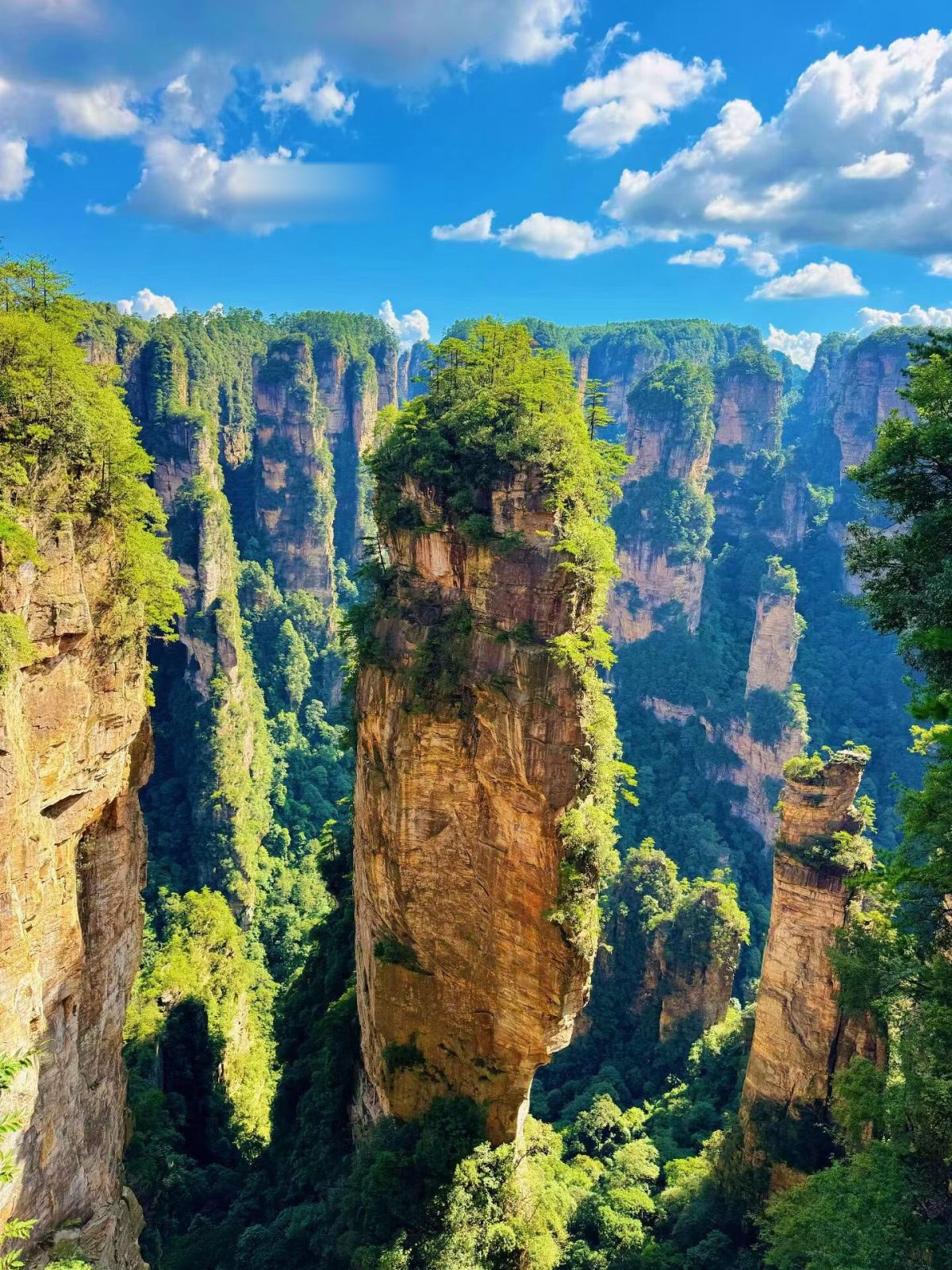
Short answer: Shoot Zhangjiajie at sunrise the morning after overnight rain, when the sea of clouds forms around the quartz-sandstone pillars. Aim for the first cable cars of the day and the two hours after, while the mist is still sitting in the valleys. The strongest vantage points are Tianzi Mountain’s upper cable-car station and Yuanjiajie’s Mihun (Lost Soul’s) Platform, with Yangjiajie as the quieter, crowd-free alternative.
Best for: photographers who can make an early start and want the floating Avatar pillars, the cloud sea and legal aerial footage in 2026. Think twice if: you plan to fly your own drone — Zhangjiajie now needs a special permit plus CAAC registration, so you must use the park’s official drone-filming point instead. Plan for: a 4-day park ticket with advance reservation required, and 3–4 days on the ground to chase the best-weather sunrise.
The best time to photograph Zhangjiajie is the early morning after overnight rain, when the sea of clouds is most likely to form around the quartz-sandstone pillars. Aim for the 7:00–9:00am window, with the orange ‘fish-belly’ horizon glow appearing about 30 minutes before sunrise. A well-planned Zhangjiajie photography tour is really about being in the right spot at the right light — and in 2026, knowing the things most online guides get wrong, from the current Tianmen Mountain cable car to China’s drone-permit law. This is how a local crew who lives here actually shoots the park.
We are a local team based in Zhangjiajie, not a Beijing agency parachuting in. Our guides have stood on Golden Whip Stream at 6am with an Australian couple waiting for the mist to lift, so the advice below is field-tested, not copied from a brochure.
The best photography spots in Zhangjiajie
The strongest sunrise and sea-of-cloud vantage points are the Tianzi Mountain upper cable-car station and Yuanjiajie’s Mihun (Lost Soul’s) Platform, which gives a near-360-degree panorama of the Avatar pillars; Yangjiajie is the quieter, crowd-free alternative. Here is the spot-by-spot breakdown for where to photograph Zhangjiajie.
- Yuanjiajie — the Avatar Hallelujah Mountain. The real-world inspiration for the floating peaks in the film is the Qiankun (Southern Sky) Column at Yuanjiajie, inside Zhangjiajie National Forest Park — one of 3,000-plus pillars in this UNESCO World Heritage landscape. Reach it in about two minutes on the 326-metre Bailong (Hundred Dragons) Elevator, the world’s tallest outdoor lift. Mihun (Lost Soul’s) Platform here is one of the park’s best sunrise spots.
- Tianzi Mountain. The area around the upper cable-car station is where the cloud sea is most likely to form — the prime spot for that ‘peaks rising out of the clouds’ frame.
- Yangjiajie. Quieter than Yuanjiajie and excellent for crowd-free sunrise. Be at the gate before it opens, because the morning fog typically lifts by midday.
- Golden Whip Stream. A crystal-clear streamside trail of about 6.5 km, flanked by sheer pillars — one of the few flat, stair-free walks in the park, ideal for forest, reflection and wild-macaque shots.
- Ten-Mile Gallery. A roughly 5 km canyon walk past named formations such as Three Sisters Peak and the Old Man Gathering Herbs. A small monorail tram runs its length if you would rather not walk.
- Baofeng Lake. Emerald water ringed by pillars rising straight from the surface — nicknamed the ‘Water Avatar’ or ‘Floating Fairyland’ — for mirror-calm reflections.
The best time to photograph Zhangjiajie
April–May and September-to-November are the two best photography windows in Zhangjiajie. Spring’s plum-rain mist (March–May) makes the pillars appear to float, delivering the most dramatic sea of clouds; mid-October to early November gives the clearest skies, the most reliable cloud seas and autumn colour. The single best moment for a sea of clouds is the early morning the day after rain.
For light planning: the best window runs roughly 5:00–9:00am, and the orange ‘fish-belly’ glow shows about 30 minutes before the sun clears the horizon. Spring temperatures climb from about 7–15C in March to 13–22C in April; autumn daytime sits around 20C with cool, clear, stable air. Park eco-buses and the cable cars start early, and opening times shift with the season and the day’s crowds — we confirm the first runs the evening before, so your guide has you positioned before the first tour groups arrive.
Shooting the sea of clouds and sunrise: the golden-hour playbook
Your best chance of a Zhangjiajie sea of clouds is the morning after overnight rain — ride the first cable cars of the day and head straight up, while the mist is still sitting in the valleys. Cloud seas form when warm, moisture-laden air settles in the valleys overnight and the sun begins to burn it off — which is exactly why the day after rain, in the early morning, is the prime window. The mist usually lifts by midday, so this is a sunrise game, not an afternoon one.
Our practical routine: pre-book the park, ride the first eco-buses or the Bailong Elevator up, and shoot Tianzi Mountain’s upper station or Yuanjiajie’s Mihun Platform in the first hours after the lifts open. Because we live here, we can read the previous evening’s weather and tell you which morning is worth the early alarm — and which to skip for a lie-in.
Tianmen Mountain in 2026: open, but not by the main cableway
Tianmen Mountain is open, but from 13 October 2026 its main cable car – billed as one of the world’s longest – is not carrying passengers: the upper section has been closed for rebuilding since November 2025 and the lower section from downtown stops on 13 October 2026. You go up by Line C: the express cable car from the mountain gate, then the escalators through the mountain. Many English-language guides are still out of date on this, which is the single biggest thing they get wrong.
- The mountain stays open. From 13 October 2026 only Line C runs; the Line A and Line B packages are withdrawn until the main cableway returns. Current arrangement: Tianmen Mountain cable car in 2026.
- The classic experience is largely intact: ride the express cable car and the escalators up, walk out to Tianmen Cave (Heaven’s Gate), and take in the cliffside glass skywalks. The 99-Bend Road is not on the Line C route.
- Operating hours are usually 08:00–19:00, with last entry around 16:00; times can shift in snow or heavy fog, so we always check the park’s same-day notice. Adult ticket is CNY 285 plus CNY 3 insurance, unchanged for Line C.
For photographers: the Heaven’s Gate framing and the summit walkways are shootable; from 13 October 2026 the 99-Bend Road and the long cableway ride are not part of the route. A local guide simply keeps you ahead of the day-trip crowds for the cleanest light.
Drone footage in Zhangjiajie: the 2026 permit law
Flying a drone in Zhangjiajie National Forest Park now requires a special permit in 2026, and every drone in China needs real-name CAAC registration regardless of weight — tourists cannot simply launch their own. Unauthorised flights in the Wulingyuan area are prohibited; even in permitted zones, flights are capped at 120 m altitude and 500 m distance, and an operator needs CAAC registration, insurance and a flight plan.
That is precisely why the practical way to get aerial footage is the park’s own official drone-filming point, not your own drone. On the China Fantasy Travel 5-day Zhangjiajie tour, we cover that official aerial-video service for you — so you come home with cinematic drone footage of the Avatar peaks, shot legally at the approved point, with none of the permit hassle. If you have read older posts implying you can bring your own drone and fly it over the pillars, that advice is out of date for 2026.
A sample Zhangjiajie photo-tour flow
A well-built Zhangjiajie photography itinerary balances effort and reward: shoot the floating pillars from Yuanjiajie and Tianzi Mountain up top, then walk the flat, stair-free Golden Whip Stream and Ten-Mile Gallery for streamside reflections and named rock formations. A typical rhythm we run for keen photographers:
- Day 1 — Yuanjiajie and the Avatar peaks. Bailong Elevator up, Mihun Platform, and the floating-pillar viewpoints; settle in for an early start the next morning.
- Day 2 — Sunrise sea of clouds. First cable car up to Tianzi Mountain’s upper station or Yangjiajie at the 7:00 opening, for the 7:00 to 9:00 cloud-sea window, then Golden Whip Stream’s flat streamside trail.
- Day 3 — Ten-Mile Gallery and Baofeng Lake. Named formations and mirror reflections, with the monorail tram as a low-effort option.
- Day 4 — Tianmen Mountain. Go up by cable car and escalators to Heaven’s Gate (route per the park’s operating plan; Line C from 13 October 2026), plus the Grand Canyon Glass Bridge — one of the world’s longest and highest glass bridges, about 300 m above the canyon floor — if you want it in frame.
An optional Hanfu & Miao portrait session — ethnic-costume photography among the pillars — is available from $299, already included on our 7-day Zhangjiajie & Fenghuang tour; just ask. We tailor the order to the weather, so if the clouds look right for a particular morning, we move the schedule to chase the light rather than march through a fixed checklist.
Our 4-day Zhangjiajie photography tour: who leads it, when we leave, what it costs
Who leads it. A Zhangjiajie local guide from our team. We are not a photographers’ collective; we are the people who know which platform has the light at 7:30 and which one is in shadow until 9.
When we leave. The National Forest Park opens at 7:00 and the Bailong Elevator opens with it. The sea of clouds, when it forms, sits in the valleys from first light until about 9:00. We leave the hotel in Wulingyuan town at 6:15, are at the gate when it opens, and are on the first elevator or cable car up.
The four days.
- Day 1, Yuanjiajie. Bailong Elevator up, Mihun Platform and the Hallelujah Mountain viewpoints in late-morning light; early night.
- Day 2, the cloud sea. First cable car up Tianzi Mountain, or Yangjiajie if you want the platforms to yourself, for the 7:00 to 9:00 window; Golden Whip Stream reflections after lunch.
- Day 3, water. The Ten-Mile Gallery formations and Baofeng Lake from the boat.
- Day 4, Tianmen Mountain. Line C, the express cable car and the escalators, for Heaven’s Gate and the cliff walkways, then the Grand Canyon Glass Bridge in the afternoon.
Each day carries a weather alternative; if the morning is in cloud with no break, we move the summit day and shoot the stream.
Drone footage. Flying your own drone in Zhangjiajie in 2026 requires real-name registration on the national UOM system and a flight application filed with the local police station in Wulingyuan, not the visitor centre; travellers report approval takes several days, and Tianmen Mountain is a no-fly area because of the airport. We do not arrange private flights. If you want aerial footage of your trip, we can arrange it at the park’s official drone-filming point at Baixiantai on Yuanjiajie, CNY 98 per flight for the whole group.
What it costs. The guide is CNY 600 per day for 1 to 4 people, plus a private car with driver priced by vehicle size, plus park tickets at the counter price. Overtime for a late sunset is CNY 100 per hour. Full day rates are on our private-guide page.
Planning your trip and China entry in 2026
Two logistics worth knowing. First, the Zhangjiajie National Forest Park ticket is valid 4 days and costs a flat CNY 236 year-round for the combined admission and eco-bus pass; advance reservation has been required for every visit since June 2025, and the ticket includes the in-park eco-buses. Children under 14 and seniors over 64 enter free. Second, on entry: since 20 August 2026 the 240-hour (10-day) visa-free transit policy has been in force for travellers from 57 eligible countries (including the US, UK, Australia and Canada) entering via 65 ports, provided you hold a confirmed onward ticket to a third country or region; separate unilateral 30-day visa-free entry covers 50 countries and, for 48 of them, runs to 31 December 2026, and from 20 November 2025 arrival cards can be filed online before you land. Always re-check the current rules for your nationality close to departure — see our China visa guide for 2026.
Ready to plan the shoot? Browse our Zhangjiajie tours, pair them with our Xi’an tours for a wider China loop, or read real traveller reviews. Tell us your dates and the light you are chasing on our plan my trip page and we will send a personalised PDF itinerary within 2 hours — or message us on WhatsApp at +86 189 7441 2915.
Frequently asked questions
When is the best time to photograph Zhangjiajie?
April–May and September-to-November are the two best windows. Spring’s plum-rain mist makes the pillars appear to float for the most dramatic sea of clouds, while mid-October to early November delivers the clearest skies, the most reliable cloud seas and autumn colour. For any single day, the early morning after overnight rain is best.
Where are the best sunrise viewpoints in Zhangjiajie?
The Tianzi Mountain upper cable-car station and Yuanjiajie’s Mihun (Lost Soul’s) Platform — which gives a near-360-degree panorama of the Avatar pillars — are the strongest. Yangjiajie is the quieter, crowd-free alternative. The best light window is roughly 5:00–9:00am.
Where is the real Avatar Hallelujah Mountain?
It is the Qiankun (Southern Sky) Column at Yuanjiajie, inside Zhangjiajie National Forest Park — one of 3,000-plus quartz-sandstone pillars in this UNESCO World Heritage landscape. You reach the viewing area in about two minutes on the 326-metre Bailong Elevator, the world’s tallest outdoor lift.
Is Tianmen Mountain open in 2026, and can I reach Heaven’s Gate?
Partly. The main cableway’s upper section (mid-station to summit) has been closed for rebuilding since November 2025, and from 13 October 2026 the lower section from the city stops carrying passengers too. Tianmen Mountain itself stays open: you go up by Line C, the express cable car from the mountain gate and then the escalators through the mountain, and come down the same way. Current arrangement, times and prices: Tianmen Mountain cable car in 2026.
Can I fly my own drone in Zhangjiajie?
Not freely. As of 2026 the Wulingyuan / Zhangjiajie National Forest Park area requires a special permit for any drone flight, and every drone in China needs CAAC registration, so tourists cannot simply fly their own. The practical route is the park’s official drone-filming point — on our 5-day tour we cover that official aerial-video service for you, so you get cinematic footage shot legally at the approved spot.
How many days do I need for a Zhangjiajie photography tour?
Three to four days lets you shoot Yuanjiajie and Tianzi Mountain up top, walk the flat Golden Whip Stream and Ten-Mile Gallery, and add Tianmen Mountain or the Grand Canyon Glass Bridge — with enough buffer to chase a sea-of-clouds sunrise on the best weather morning. Tell us your dates on our plan my trip page for a tailored schedule.
Who runs photography tours in Zhangjiajie with sunrise access?
China Fantasy Travel, a Zhangjiajie-based private tour company, runs a four-day photography itinerary that puts you on the first elevator or cable car at the 7:00 opening, when the cloud sea is thickest. The park does not open before 7:00, so no operator can put you on the summit before then.
Can your guide get drone footage for me?
We can arrange filming at the park’s official drone point on Yuanjiajie, CNY 98 per flight. We do not arrange flights of private drones, which need a permit and registration in 2026.